Saturday, 2 April 2011

Meeting expectations

Mostly, when you actually meet and photograph a public figure you quickly find yourself changing your previously held opinion of them. The side that seldom emerges in the spotlight of the TV camera often reveals itself in the more relaxed environment of an interview or portrait shoot.

This is probably never truer than in politics. So much currently rests on public perception and so many of those around power feel the need to exert their influence that the gap between how politicians appear in the media and how they are “one-to-one” frequently leaves me unsure of how anyone could juggle such disparate personas.

For most of the nineteen-eighties I was a teenager. It was a time of great social polarisation and upheaval and one of the biggest beasts in the politics of that era was Norman Tebbit. He was the kind of hard-line Conservative that was a magnet for the right and a figure of genuine hatred for the left.

A couple of decades later and he is, to quote Gill Scott-Heron, “no longer so damn relevant!” but he remains active in politics and an undoubted thorn in the side of the current Tory party whose desperation to shed the past image often borders on illness.

When I got the commission last week to photograph Lord Tebbit of Chingford on the eve of his Eightieth birthday, two thoughts went through my head: The first was inevitably the caricature of him as a skinhead thug on the TV satire Spitting Image. The second thought was, “there’s no way he can possibly be as reactionary as he seems”.

Accompanied by writer Matthew Bell we met in the central Lobby of Parliament, the brief walk to an interview room in House of Lords led through imposing splendour past one of the greatest under-viewed art collections in the UK to a manned elevator whose interior is so ridiculously small that it was barely possible to fit all three of us in one trip without crushing the cheerfully knowledgeable West African lift operator.

With the interview underway, Lord Tebbit seemed only too happy to talk. Although, “happy” might not be the word.

Everything about the modern world seemed to irritate him and stand as proof of how much better it all was when he was younger. His sharp intellect and amazing life experience (Fast jet pilot and journalist amongst others) seemed at odds with several of his more illogical assertions.

He is sceptical of the contribution made to UK life by immigration but staunchly denies any racism - hilariously citing the fact that he is friends with Bishop John Sentamu and Nasir Ali and seeing this as proof-positive of his open-mindedness.

He hates the BNP (British National Party) with a passion but mostly because he believes them to be socialists and they advocate centrally planned economic policy - a fact of which I was unaware but which most would consider the very least of their faults as a political party.

He loves nationalism in all it's forms and seemed blithely unaware of the terrible violence that it often spawns. But most of all he hates multiculturalism.

Not so much a, "Glass half full or half empty?” sort of guy. More of a, “Better keep hold of that glass or some scrounger will come over here and drink the rest of it!”

Matthew did his best to challenge some of the relentlessly negative statements but I never got the slightest sense that even the most rational argument could persuade him to reconsider any of his views.

As time came to do the photos he unhelpfully asserted that, “photographers just take as many pictures as possible and one of them is bound to come out!” which did not endear him to me - but, in fairness, there is no earthly reason why he should care what I think.

The wallpaper in this particular room was fantastic, classic and yet contemporary, reeking of pomp and taste and still somehow slightly kitsch. I instantly knew that I wanted it to be an integral part of the picture rather than just the backdrop.

A true blue Tory caught in a thicket of Labour red and Liberal Democrat yellow.

Ordinarily I might get the subject a little way forward and let the wallpaper fade out of focus and out of the light but I have been doing an little too much of that recently and I wanted a punchier, more aggressive look to the lighting and the final image.

Using the 30cm square diffuser for my Q-flash, without the front baffle so that the silvered innards were visible, I taped a small piece of white card in front of the bare bulb to act as a rudimentary bowl and spoon. I knew this would give me a slightly harsh, almost ring-flash look to the light as long as the reflector was close to the camera.

Pressing my unfortunate writer into service as an impromptu assistant I shot a series of expressions both to and away from camera but as often happens it was a bit of luck that gave me the idea for the best picture. Mathew’s slight frame was not built for the rigours of holding a flash on the end of a pole above his head for long periods of time and it slipped lower and lower as his arms started to ache.

When his muscles eventually gave way there was a strong shadow across the top of the background. Looking at it on the back of the camera I thought I had accidentally jogged the shutter beyond its synch speed. The minute that his arms were working again I reset the light – lower and pointing a little downward giving an effect rather like the light you might see in the smoky backroom of an old gangster movie.

Somehow it seemed appropriate for a man who was once a political enforcer for Margaret Thatcher. The harsh light illuminating his eighty years of life experience. Every crease of his face by now pressed into a hard stare.


So here he is, exactly as unreconstituted as he appears. Not worn down by age or the tide of public opinion that seems to have been running against him for decades. An immovable object, a man of conviction and strongly held beliefs - but not my beliefs.

Sunday, 30 January 2011

They don't make them like that anymore!


When I was growing up there were very few highly visible Scientists. But about the most visible of all, (possibly even from space!) was Patrick Moore. His rapid-fire delivery and astonishing knowledgeability always gave the impression that there was so much inside his head that it kept squirting out as though his skull could no longer constrain it.

Of course he is SIR Patrick Moore now and not such a feature of British television at the age of ninety as he once was but when I had the opportunity to photograph him last week I very quickly realised that he is still a force of nature.

A gradually deteriorating war-wound has left him confined to being seated or lying, his spine no longer able to bear the strain of standing. His hands and fingers seemed to visibly frustrate him as they refused to do as he commanded. But while manual dexterity may elude him, his mind is still limber. Sporting a bright Hawaiian shirt that lit up the room on a grimly grey January afternoon, he talked about the cosmos, cricket and his cats on whom he dotes.

He sat on a swivel-chair in his study - his mission control, every inch the English eccentric you would want or imagine him to be. Occasionally he pointed out some of the things around the room and recounted the memories attached to them. The sheer number of framed academic achievements alone was overwhelming but what made it more impressive were the models, books, bits of rock, photographs and ornaments that covered every available surface, all of which had a tale to be told.

To reach one's nineties and be so lucid and fascinating is a rare talent. When it came to making the portraits, I decided to glory in his age rather than gloss over it. The limited space and the fact that there was only one direction I could shoot meant being careful about where to set-up the lights. Two of his friends who lived locally had turned up by surprise and I had to pick my moments too, avoiding times when he was speaking. Added to which, the ancient mullioned bay windows meant that it was impossible to avoid reflections. But I slowed the shutter, letting a little daylight though to neutralise them.

As I gingerly stepped backwards and pulled the shot wider to include more of his study I saw the single bare bulb directly above his head. It reminded me of the way thoughts are illustrated in cartoons. It felt appropriate for a man whose life has been lived so intellectually. Indeed, at that moment, he did seem somewhat cartoonish; larger than life, seemingly indestructible and with a light-bulb appearing above his head as though a brilliant idea had just occurred to him.

The brilliant idea turned out to be a large Gin and Tonic but I was driving and so he and his friends chatted amiably as I packed away my kit and prepared to give my colleague a lift to the station.

Sir Patrick Moore, Astronomer extraordinaire, cricketer, author and accomplished xylophonist (though no longer playing), living legend and national treasure, has a new book out at the end of February. Paul Bignell's interview with him in the Independent on Sunday can be read here. Hope you enjoy it.

Saturday, 29 January 2011

Monday, 29 November 2010

Fireman v Corespondent


A fortnight ago I posted about Eid in Jerusalem and received a very interesting comment from Dominic Tyler about the way in which different kinds of photographers approach photojournalism.

To those uninitiated with the British journalistic slang, a Fireman is someone who travels to foreign countries to cover stories, often at short notice and in response to a breaking news story or emerging issue. A Corespondent is someone who moves to a foreign country (usually temporarily - but not always) in order to cover the news from that region in depth for an extended period of time.

In the course of my work I have been both. Initially I was a Corespondent based in New York for the better part of the Nineties and covering US news and features. Of course the US is vast and a Corespondent often travels within the country but essentially my introduction to working abroad was here.

During the best part of that decade, my friends and colleagues would occasionally visit and I was always surprised (and sometimes envious) at how they made great pictures of the things I overlooked. Familiarity can breed contempt and I think I was guilty of taking the everyday things for granted in New York.

Sometimes I would kid myself that these were tourist pictures and therefor not the kind of thing I would visit. In fact I used to pride myself on having done all my tourism in one day when I first arrived in NY and then set about the business of really knowing the city as a resident rather than an interloper.

Wow, what a trick I missed! Looking back, I wish that I had not striven for nonchalance. I shot several good news pictures in those years, some of them within shouting distance of iconic even. But my library of daily life in New York could be easily surpassed by a moderately talented photographer with a spare 48 hours in the city.

For seven years or so after 2000 I found myself in the Fireman role, flying at short notice to cover stories (both breaking and simmering) in Europe, the Middle East, Africa and Central Asia. In these places I tried to correct what I had come to see as the lost opportunity. Photographing the whole time, almost compulsively, determined to collect the strange, fleeting worlds I was seeing. Inevitably perhaps, it was too far in the other direction.

In 2002 I spent several weeks in Kabul on the anniversary of the fall of the Taliban. While there I met Steve Connors a British photojournalist living there for a few years who kindly took the time to point out the middle path. Learning how to have patience and to resist the temptation to immediately photograph everything one sees is about the hardest trick I have ever attempted.

Patience reveals the hidden facets. Only once people have grown accustomed to you without the camera are they likely to be candid and comfortable when it finally appears. Patience leads to atmosphere in pictures which in turn, gives them a lasting quality. Moments are like speaking a foreign language from a phrasebook, atmosphere is like speaking that language fluently.

Of course, the life of a Fireman is rush, rush, rush. Hard to show that level of patience on an assignment where you often have only a week or less to do a complex story. But Steve's advice did serve me well a year later when I spent several weeks in Baghdad. There were the usual hurry-ups on daily stories but whenever possible I went out and looked at things patiently and waited till I had a better understanding of the rhythms of daily life around me before trying to photograph it.

So what have I learnt from approaching things in these distinct ways? Not enough.. you can never know enough, but I am now more open to subtleties and nuance. I have learnt to re-examine what I might have previously dismissed as obvious, or overlooked as banal. So now its a question of constantly trying to blend the best of the different approaches to each situation.

A group of girls walking around old Jerusalem. Laughing and chatting, one of them carrying an assault rifle with double clips taped end to end for quick reloading in a fire-fight. Looks completely alien to me but it's absolutely normal behavior for them. If I lived in Jerusalem would I ever get to the stage where I just filtered-out this kind of thing? Don't think so, but maybe that's the fireman talking!

Tuesday, 16 November 2010

Eid Al Adha

The photographic language of the middle east is so often tied up in the most dramatic incidents and extreme behavior. On both sides of the political and ideological divide photographers have inevitably been seduced both by the horror of violence and the mawkish romance of suffering.

I have been guilty of this too. My first assignment in Israel and the West Bank in late 2000 was filled with trips to refugee camps, desperate hospitals, besieged settlements and the fighting at the Ayosh Junction in Ramallah (where the violent clashes happened with a horrible kind of predictable regularity that would make a swiss railway timetable look slapdash!) It was a terrifying, awful cocktail of tragedy and as journalists we were all (completely legitimately) committed to fearlessly, unflinchingly and repeatedly reporting the dreadfulness that was unfolding.

The intervening decade between my last visit has not seen a great deal of improvement and many aspects are much worse.

But as I stepped out in the first light of dawn yesterday to photograph the celebration of Eid Al Adha I was overtaken by the uneasy feeling that I had missed something important about the essential nature of life by ceaselessly pursuing the headline moment. The impetus to re-examine my persona approach came from conversations with my friend and colleague Geert Van Kesteren who has been producing extraordinary and insightful photojournalism from this corner of the world for many years and has gained a deeper understanding than most about what effect the international media coverage is actually having.

We walked up the hill through Silwan towards the Dome of the Rock. As we progressed, the numbers swelled, all heading to the mosque and afterwards to the graves of their relatives to offer prayers and honour their departed family. The atmosphere was one of understated, dignified observance. Neither solemn (although many were quietly tearful) nor really celebratory. Children sat respectfully talking and showing one another their Eid gifts but there was no boisterousness or sudden movement. Some were dressed conservatively others more casually. Amongst the pictures I made, this one seems to illustrate best what I experienced.


The men of the family; silently reflective, modern in appearance yet traditional in values. They had about them, a certain contentment in fraternal contemplation and occasional conversation. Reading the Quran or even the newspaper, but at all times this unspoken comfort in their duty and respect for the occasion. It is the first time I feel as though I've captured something more subtle and relevant to everyday life in my photography of this particular issue. Perhaps it was the first time I've had the necessary understanding to even be able to aspire to that.

Sunday, 14 November 2010

Breaking Mr Bailey's rules

David Bailey has probably forgotten more about Portrait photography than I will ever know and for that reason his cardinal rule that your subject should never have their hands on their face unless it is for very dramatic effect has been a guiding principle for me in all instances.

But on a gorgeous sunny autumn morning a few weeks ago in Primrose hill I broke his rule (and mine) and lived to tell the tale - just about.

With the sun streaming in through the windows of the Albert Pub and a coffee on the go I started the preparations to photograph Hayley Atwell, star of the new adaptation of "Any Human Heart" (starting on November 21st - Channel 4). I cleared the decks of all extraneous furniture and set up the lights, placing one small bare table and chair in the empty space I had made. In the background the sun lit up an etched window and the dark wooden floorboards soaked up the spare ambient to give it a nice contrasty feel.

Flare looks great on the Canon 5D and the strong sun just cresting over the rooftops of the houses opposite, gave me inspiration. Now it's not very clever to get too wedded to an idea but somehow I wanted to bring that beautiful day inside and no matter what I tried to set up as a second shot, I kept stooping to get the rings of red and green flare bursting through the frame, completely seduced by the atmosphere.

Hayley exuded a kind of warmth and dare I say it, a certain dreaminess too. Chatting away, she sank into an elegant outline with her face resting naturally on her hand. My immediate reaction was to stop shooting but she looked so relaxed and fixed me with an enigmatic smile that I just couldn't read. So I carried on taking pictures.

I spent ages looking at this frame during my edit and I've since gone back to it, trying to decide what that expression is. Sometimes I think it's cool and detached sometimes it looks as if she is recalling a memory or caught in a pleasant daydream.

Truthfully it's unlikely I'll ever to know for sure what was going through her mind but an occasional mystery can't hurt. In the meantime, the "hands away from face" rule is back in full force!

Tuesday, 19 October 2010

Friday, 15 October 2010

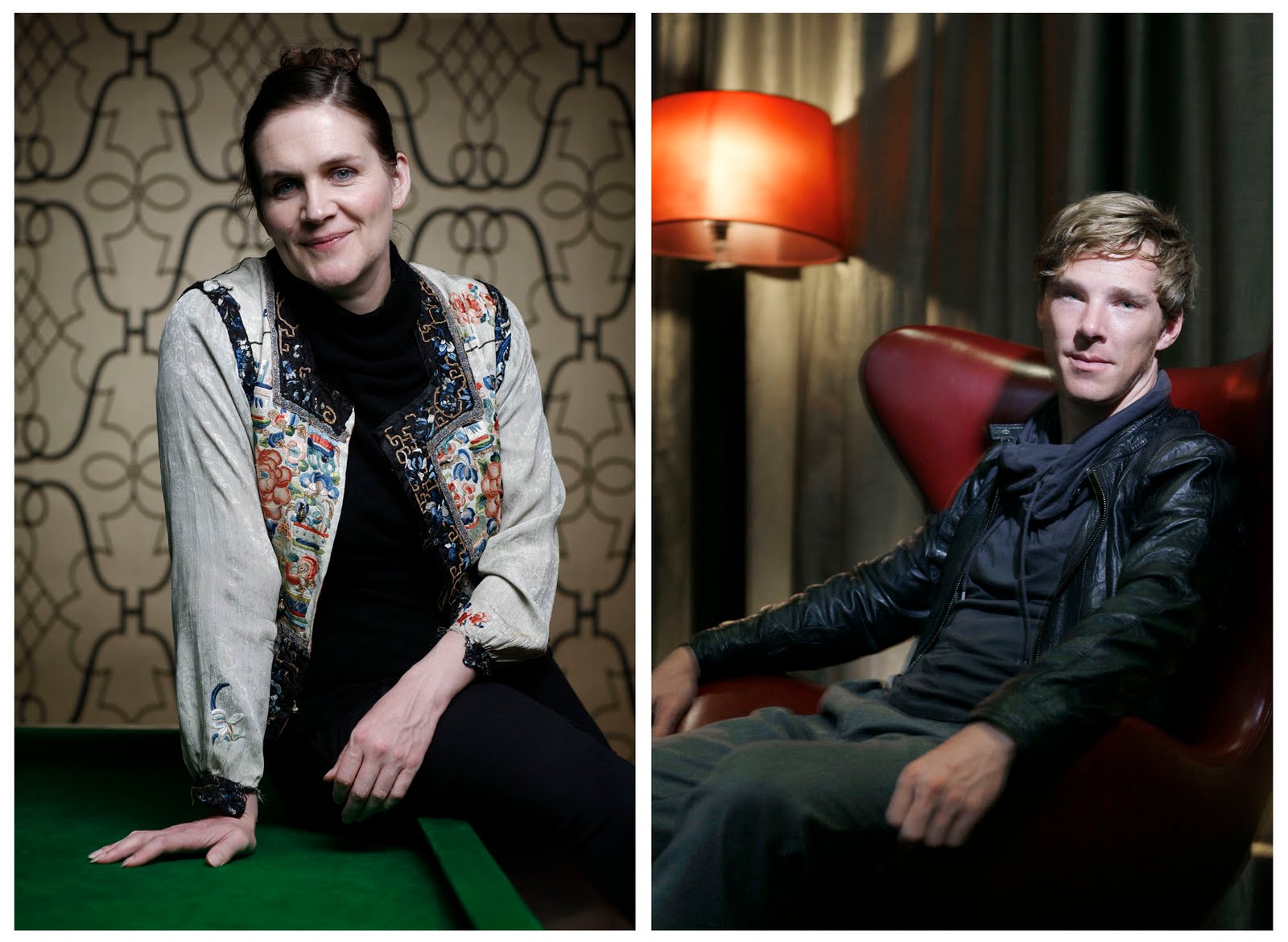
Sophie Fiennes and Benedict Cumberbatch


When I set out last Thursday my schedule looked pretty leisurely. One profile portrait in the late morning and one in the late afternoon and clear space in between to ingest, do an initial edit and acquire from raw. But Schedules have a habit of sliding. Job one gets put back an hour Job two becomes job three and then hey presto! at the last minute a fourth portrait has to be filleted into the ever contracting time-scale.

Of course, by the standards of any Fleet Street news photography this would still be a pretty cushy line-up but I wanted to light all of these and really take time to get it right.

My first assignment was the film-maker Sophie Fiennes to be photographed in a soho club. She was delayed and given her family name it would be easy to assume that she was running late from a clutch breakfast TV appearances. But in truth, it was simply that she had a bit of a nightmare with getting her baby buggy onto the bus from South London where she lives. Ah how refreshing!

It turns out that my vague expectation of theatrical intensity couldn't have been wider of the mark. The night before I had tried to do a little research including watching a clip from her 2003 documentary "The Perverts Guide to Cinema." This is a serious and thought-provoking philosophical examination of cinema. So I'm still not quite sure why I imagined that she would be late due to extended carousing with the green-room glitterati of the morning TV circuit. It is a patently ridiculous image but there you are - the mind is a funny thing.

Anyway, it gave me time to prepare and pre-light. When I first invested in portable studio lighting I decided to go the Profoto route. This was mainly because of their abundance in the rental market. I had used all sorts of kit for various shoots but Profoto seemed to be the industry standard for rental in the US and not only was it therefore the most familiar but also it meant that any additional kit I might need from time to time would use the same reflectors and light-shaping tools that I was already buying.

For these short shoots I tend to use the old-style 600ws mono-block because it is so quick to deploy and the fine-tuning is child's play - one twisty dial with clearly marked stop-fractions on it. So up it went, with a medium Chimera soft-box and an egg-crate to limit the spill and reflect black into the skin for punchy details.

Having finished the interview Sophie arrives in the room set aside for photos. Completely friendly and down to earth, she breezes through the shoot and even jokes about trying not to look too stern. Her only concern is to get back to her new (and first) baby so with that in mind, I aim not to take any more time than is needed.

At the other end of the day; a late arriving assignment to photograph the actor Benedict Cumberbatch whose recent portrayal of a modern-day Sherlock Holmes won praise from critics and (more significantly) from my teenage son!

At the BBC building where the interview is scheduled they do not allow photography so we agree to take the movable feast across the road to the lobby of a rather smart hotel (who asked not to be identified in any pictures) and I go with his publicist to speak with the manager for permission to take photos there.

Manager arrives and the Publicist sweetly explains that we are doing a little interview and would it be possible to take a couple of pictures. She promises that there will be no disruption and wont take long. Manager agrees as long as we make no mention of the hotel in the pictures or captions.

All good! We return to the lobby and I get to work.

Ezra Stoller claimed that location work is 5% inspiration and 95% moving furniture! This however is nearer 99% and soon the pristine lobby looks like an unprovoked act of aggression by the Furniture Liberation Front.

For some insane reason I decide to use a grid spot for this picture and end up with a beam of light that is a bit too narrow and without adequate space to move the light back to soften the fall-off. Switching beween grids and then repositioning the light is easy with a bit of help but on your own it's slow and each adjustment feels like it takes forever.

Luckily for me, Benedict is completely chilled and HIS only concerns are a change of shirt and not appearing to be Sherlock in private life as well as professional.

It's at this point that I really wish there was enough in the day rate for an assistant. Every tweak of the lights eats a little more time and a little more patience. I get tantalisingly close to the picture I want but in the end we just run out of minutes and space.

Chalk it up as a draw rather than a victory.

Friday, 8 October 2010

Diary picture - 29 May 2010


Just had my fix of caffeine at the Monmouth coffee shop. Steps away I see this torn poster and the bricked up frames to avoid the old window tax. Compelling but simultaneously creepy.

Light's just right. One shot, wide open, walk on.

Tuesday, 5 October 2010

Magwich country


Even though I live in north-east Kent and frequently travel across the marshes riding the train to London, I have never actually spent any time walking there. On sharp autumn mornings they are quite stunning in their stark beauty but, like much that is close at hand, there is a tendency to take it for granted. And to my shame, I've never explored them.

So it felt like fortune was smiling when Sophie at the Independent on Sunday called and said, "I have a treat for you - travel piece about the Kent Marshes. Should be right up your street... quite literally!"

It had threatened to rain all morning but as I parked near Cliffe in north Kent the cloud had thinned just enough to see some detail in the sky and the occasional slip of blue. Armed with a printout of the piece, written by Tom Connolly, a really evocative read, I instantly wished for a few days more to try and get a variety of weather to do it justice.

A camera over each shoulder and two pouches on my belt (one with an extra lens and the other one with cards, batteries and my extension tubes for any close-ups) I strode out over the network of gravel pathways. I decided to work with three prime lenses (35mm 1.4L, 85mm 1.2L and 135mm 2.0L) rather than any of my zooms. Partly because I had the luxury of doing so but mostly because I craved simplicity and discipline.

Photographers always talk about the quality of image you get from fast prime lenses but they also have the benefit of forcing you to move around more to change your shot and in doing so you often see things that could easily be overlooked by just constantly re framing with a zoom.

The landscape is a strange compelling mixture of rural, coastal and industrial, In some ways it feels unchanged since Dickens but then there are the docks, power stations and oil refineries that serve as constant reminder of modernity.

I love this kind of solitary observational photography and I only saw four people during the course of the day. Walking their dogs or carrying binoculars and wildlife books they mostly just gave a slight nod of the head as we passed each other.

One of the things that makes this area so compelling for me is the bleak expanse of grasses, ditches and pools set amongst the crumbling remains of industry. A WW1 munitions factory had been here but long gone now and leveled to the point of near invisibility unless you get close. What little remains by way of bricks and structure is slowly, inexorably being reclaimed by nature, covered by grass or providing a wind break for the horses and cattle. Occasionally a bit of random rusting pipe-work bursts from the brambles, both incongruous and somehow perfectly appropriate here.

Heading east I drove to Chetney Marsh. The shortening days of autumn drawing in by then and the sky had become a misty featureless veil. Through the fading perspective duo-tone of grey and green I could make out the Island of Grain docks and the smallish shipwreck that Tom had described in his copy. In the middle of a field was an old stile. The fence it once brooked had been moved or broken down. Just another of those strange traces of man's history here that had decayed and been left a hostage to the landscape.

Ironically it was the marshland closest to my home that ended-up unphotographed. By the time I returned the weather had made good on it's early threat of rain and a persistent drizzle had reduced visibility too much to continue. The next morning was much the same story so I'll have to make the effort to explore it at a later date.

Tom's wonderful and atmospheric piece is published here please treat yourselves and read it. There is a link on the page to see more of the photographs. It turned out to be exactly what I needed - a break from traffic and rain and overstuffed schedule in a week that was to become all of those things.

Sunday, 26 September 2010

On the way to.... Tora Bora, at breakneck speed.


Four years ago, on assignment for the Sunday Times Magazine, I had the rare and almost certainly unrepeatable experience of visiting the mountains of Tora Bora on the border between Afghanistan and the tribal areas of Pakistan.

Specifically we were to visit the abandoned camp where Osama Bin Laden had made his stronghold and from which he had escaped in the closing weeks of 2001 to the spectacular fury of the coalition forces who hunt him to this day.

Loaded-up with what seemed like enough fighters and weapons to start a decent-sized war, finish it, enforce the peace and then start it all over again, we set off for the place where the road would run out and the walking begin.

Flat countryside gave way to foothills and winding tracks which in turn became narrow barely navigable pathways around the outside of the mountains with precipitous drops on our left and sheer rock-face on our right.

Naturally, it was at this point that our driver sped up to around 70kph on the bumpy gravel track and we started to barrel along in a kind of unguided relentlessness that was really fantastically unpleasant.

Long-time partner in misadventure Charlie Alpha, raised her voice to be heard above the revving engine and asked why it was quite so important that we go this fast. The commander in the front seat smiled, turning backwards to face us and, pointing to the road, he said, "chakria Al Qaeda" (Al Qaeda street).

"This stretch of road, we do not control," he continued, "if we go any slower we will be attacked."

With repeated stabs of his fingers and a curious reverse clap movement he made the international hand gesture for gunfire and large explosions.

We got the message.

So there it was, the simple choice between being attacked or plummeting hundreds of feet to certain death. It was a marginal call, but not ours to make so we braced against the roof of the car to stop ourselves being launched upwards to a spinal injury by every pothole, and held on until we were through the danger area.

As we started to wash off some speed, the road opened up and we caught the first uninterrupted view of Tora Bora. Charlie wound her window down and we snapped away like tourists passing the Acropolis.

Both of us marveling at our driver's skill, remarking (somewhat sarcastically!) upon what a travesty it was that there were no Afghans driving professionally on the World Rally circuit and both trying desperately to ignore the fact that in a few hours we would have to make the return journey, probably in fading light!

Wednesday, 15 September 2010

Collecting the children from detention.


As strange as it was lining-up to enter the Taylor Wessing prize (see "Showering in public") it pales in comparison with the experience of collecting work that didn't get selected.

What a difference in atmosphere! Gone was the swagger, the passive aggressiveness the "not daring to hope" crackle of expectation and in its place the dole-queue drudgery of those whose dreams have been stamped like kittens.

Personally I took the approach that, as with all photography competitions, lots of great photographers submit work, a few get chosen but it doesn't mean that those who did not make the edit are collectively a dreadful, talentless, waste of blood and organs. Indeed many of those collecting prints at the same time seemed to be rolling up very nice work indeed so plenty of wonderful pictures were undoubtedly passed-over.

However there was, amongst my fellow also-rans, a certain tension. One girl tore the plastic sleeves off her prints and stuffed them into her backpack with the kind of simmering, clenched-jawed resentment usually reserved for naughty children whose angry parent's don't like to "make a spectacle" in public.

Another folded her prints aggressively as I, overcome by curiosity, took a quick glance. Which seemed particularly bizarre on three counts.

Firstly I always imagined that Photography was about communication so why would you try to stop someone seeing your pictures. Secondly, why fold prints that you've taken the time to collect? Why not just let the committee dispose of them. Finally, what possible harm could come of me seeing the picture? Given that neither of us had won anything, plagiarism seemed an unlikely outcome!

I collected my three prints along with four of Abbie's and five of Sarah's, put them in a cheap but sturdy clear plastic portfolio to prevent them from being damaged and walked out with a smile on my face and a song in my heart.

Only one of my pictures (and not the one above) will be chained to the radiator in the attic and fed gruel, the other two make me as proud now as they did the day they were born!

Saturday, 4 September 2010

Easier with honey...

Much has been written in recent years about the creeping restrictions being imposed on photographers. Security staff and Police seem to be only too keen to wade in and try to prevent photographers from going about their lawful business, especially in areas where the distinction between "private property" and "public right of way" is a bit hazy.

The security at Canary Wharf and Broadgate are both renowned for their hysterical over-reaction to anyone taking pictures and I have had Policemen argue that I was engaged in "commercial photography" at a large protest march and therefor needed a permit. His spectacularly half-witted logic was, "They don't give the magazine away for free, do they?"

Earlier this week I was approached by a security guard at Adventure Island whilst taking pictures for a travel piece about the resurgent attractions of Southend-on-sea. As he walked towards me I fully expected the standard "You can't take pictures here" routine that almost always deteriorates into a bad-tempered demand for my camera or memory card.

However, what ensued took me completely by surprise. Looking at the two cameras and my belt pouches stuffed with lenses, batteries and accessories he said,

"Excuse me sir but I'm not sure you're aware that we operate certain restrictions on photography here. If you wouldn't mind going to customer services, they might be able to help you."

His manner was calm, professional and non-confrontational. No fuss, no sneering and no condescending sarcasm. He proceeded to give me concise, accurate directions to the customer services hut and once there, I found a similarly helpful attitude.

There was a polite request to explain what it was that I wanted to photograph and for whom and after a brief call to a member of the management team I was told that it would be fine to continue and that if I should ever need to return that they would try to accommodate any reasonable request.

It was a remarkably unrepresentative encounter that demonstrated exactly what can be quickly accomplished if simple courtesy is observed by both parties. Later I came across the same guard and thanked him for being so straightforward. He explained that there was a growing problem with people trying to photograph children surreptitiously which he took exception to, but he was genuinely pleased that the management had been helpful in the case of a professional.

It has reminded me not to prejudge peoples behavior or stereotype them and that while we as photographers have rights we also have responsibilities - certain situations call for cooperation.

Friday, 3 September 2010

Lights and a plan.

Since hearing that I did NOT make it into this years Taylor Wessing selection (See post 8th August post - Showering in public) a new attitude toward my portraiture has preoccupied my thoughts. It has occurred that my reliance on available light is causing me to repeat the same picture over and over.

So when I was given an assignment to photograph Labour Leadership contender David Miliband, I immediately decided to break the cycle and pack my full lighting kit.

Using available light is the first instinct of anyone who has come up through documentary photography. It relies on observational skill, there are fewer things to go wrong and it offers the promise of flexibility - if the shot isn't working you can quickly move without fuss or fanfare and change the setting, background, tone etc.

IN the late 1990's, living in New York, I started to do more work for the magazine supplements. It required that I learn about lighting as very few clients were interested in "available lit" portraits at the time. To begin with, the hardest thing was not technical but the basic fact that when you set up your lighting, that's where you'll be taking the picture. In essence, your first instinct has to be good because there is rarely time to change your mind.

This is not always true of course. Some people have hours to spend on a shoot, others barely minutes but the leisurely ones are few and getting rarer all the time.

Learning to make those quick choices and envisage what something "could be" after a lifetime of trying to leave everything "just as it is" proved tricky and I invariably chose lighting that mimicked a diffuse window for the first year or so.

The great advantages of lighting are that by controlling the light you cease to be dependent on the amount and nature of your ambient light and you can choose lighting that is relevant to your subject and or setting. Also there are advantages of creativity over observation sometimes.

At the beginning of my journey into lit portraits I read a fascinating interview with Nigel Parry who talked about the experience of photographing Bill Clinton in a very short time-slot.

Amongst the many things he revealed was the fact that he had spent the night before the shoot doing timed a run-through with lighting set-ups so that he and his assistant could get what they needed before the curtain came down.

So the night before I decided on how I would light my portrait assignment. I picked three set-ups, all fairly straightforward and tailored to the assumption that it would be done in bare offices without any real environment that would pertain to David Miliband himself.

A quick run through led me to discard one of these ideas as, without an assistant, it would take too long to put-up and I suspected that time would be fleeting.

I am not as expert at lighting as some of my friends like Drew Gardner. Also, although I have three Profoto heads of various powers and a few light-shaping tools I do not have a limitless array of lighting weaponry.

Nonetheless I came up with a way of getting two distinct looks with a simple one-light configuration by just swapping the 20 degree honeycomb for a gridded soft-box and rotating the lamp-head so it skimmed in front rather than smacked into David's face.

This was primarily because I liked the idea of spotlights and all the metaphors they engender within the context of political power but also because they were quick to change and likely to work in whatever space I found at the location.


The coffee cup was his idea and came as he took a quick revivative swig while I quickly changed the light-shapers.

"I like this, it feels natural - like something I do regularly" he said.

"Yeah, it looks comfortable. It's honest, and there's not much of that going around at the moment," I jokingly replied.

I was lucky with the room in that the slope of the roof gave me a little visual interest to the right of the frame which seem to work if I lined his shoulder with the vertical of the corner. It gave another feature to distinguish from the spot-lit pictures shot a few feet over to the left which was a bonus.

Of course lighting all the time is just as likely to take me down a photographic cul-de-sac as using available. But for the time being my mantra will be "Carry lights and a plan" and if the sun is particularly lovely I can always switch them off!


Tuesday, 24 August 2010

Being a professional intruder.

Even after more than two decades of work as a photojournalist I am constantly humbled by the open, generous nature of people I photograph.

What we do is often intrusive by nature. The sense of awkwardness that most people would feel when pointing a camera at a stranger is one of the first things that a photographer has to overcome in order to be a documentarist.

But it's all too easy for that initial reticence to be replaced by a strange sense of entitlement. This can lead to a disconnect between you and your subjects which means that pictures become insincere, glib, gimmicky or just no good at all.

Photography is communication, we should mean what we say.

Earlier this month I photographed Olga Rodriguez and her daughter Ana Attia who has been left in a persistent vegetative state for the last six years after hanging herself in custody. The hospital where she is being treated are understandably concerned with her welfare rather than media campaigns for justice, so discretion was paramount.

Packing a single body with my bright and trusty 35mm 1.4 into a small, ordinary shoulder bag, I met Olga and her adult son and went to visit Ana at her hospital bed.

So as not to disturb other patients or make anyone feel uncomfortable, we drew the curtain around Ana's bed and I took some photographs for the family of all three together.

Their tenderness towards her was extremely moving and doubly so for the fact that my presence did not inhibit them. They were baring their souls to a complete stranger with total candour and dignity.

Over the years I have photographed in many different situations, some very dramatic, others not. But here was one of those times where you are reminded of the covenant we have as photojournalists: A voice for the voiceless, or at least for those that struggle to make their voice heard.

As I took the photos, the thought kept coming to me, "When people see this picture I want them to see and feel the love that I am seeing now. I am an intruder here, do it justice but don't endlessly shoot the same picture."


It is an essential part of my work to really feel that discomfort of intrusion and not try to deny it. I never want to get to the point where it no longer bothers me. I only ever want to conquer it momentarily in order to take the pictures and while it has never inhibited me, the fact that it takes effort to overcome is something that I hope never to lose.

This tragic case and Olga's fight for justice on behalf of her daughter highlights some of the problems involved with the provision of mental health care in the prison system and I would recommend you read the article by Nina Lakhani writing for The Independent (here).